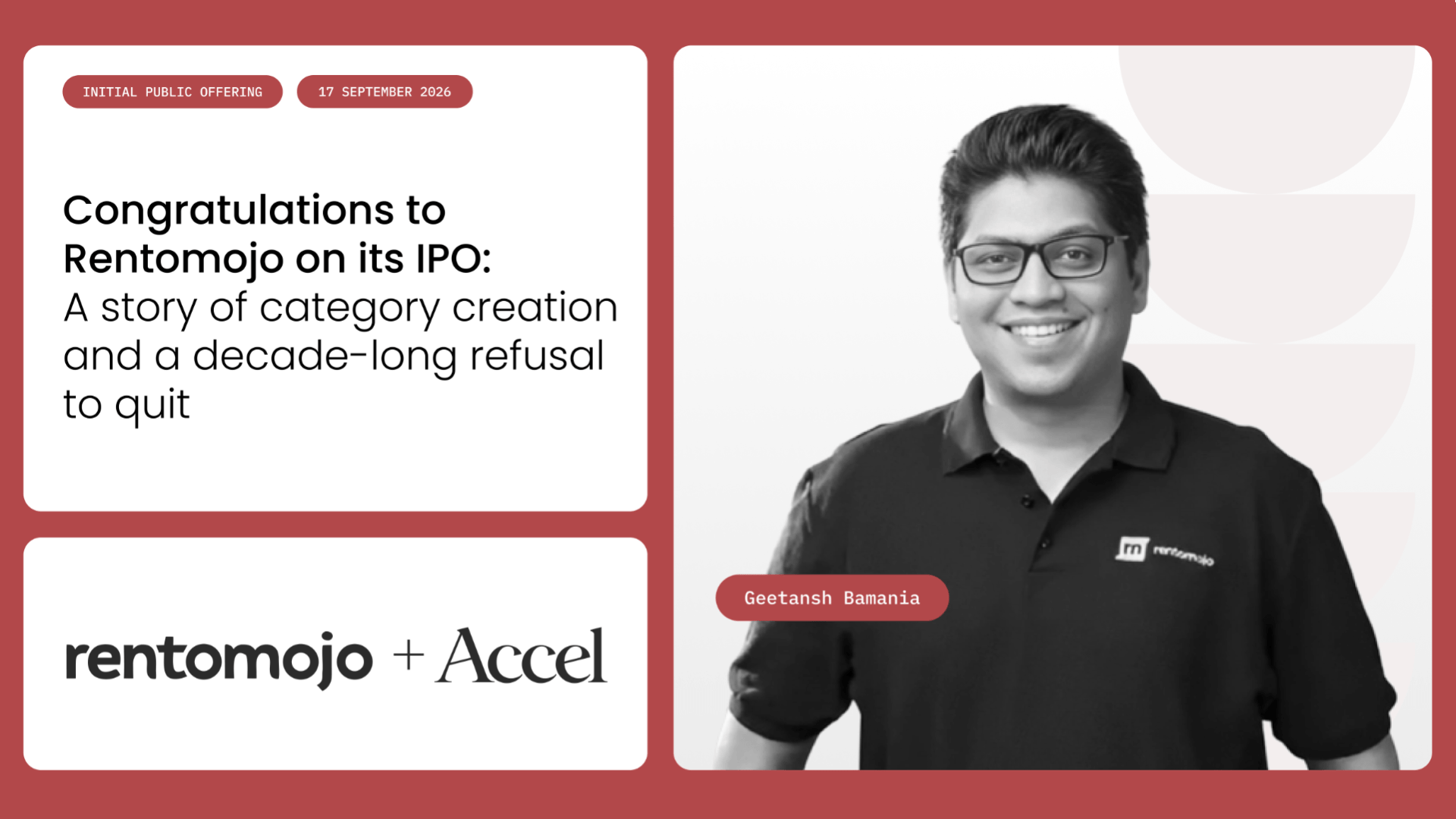
A Decade of Owning Less, Living More: Celebrating Rentomojo's IPO
In 2015, Geetansh Bamania walked into our office and said something almost nobody was saying yet: rent furniture, don't sell it.
The obvious question was why would anyone do that? There was no benchmark to refer to, no global company proving the model worked, no playbook to borrow. We spent four or five months talking with him before we were convinced. This was category creation from scratch, and Geetansh was certain it would be the future of India.
A decade later, Rentomojo hits the public bourses, and we've had the privilege to watch this category get built from nothing into the new normal. Worth looking back at what it actually took to get here.
Rentomojo started with a question nobody was asking
Geetansh grew up in a joint family, where the small work of running a home, repairing things, passing them on, was simply shared. But the India around him was changing. People were moving cities for work in numbers the country hadn't seen before. Families were getting smaller, careers more mobile, the idea of home less permanent. And yet furnishing one still meant buying a sofa, a bed, a fridge, a washing machine, then figuring out how to move, sell, store, or replace all of it when life changed again.
Geetansh saw a secular shift in asset ownership, driven by urbanization: what if Indians no longer had to own everything they lived and moved with? That question became Rentomojo.
For one part of India, renting meant furnishing a home without taking on debt to do it. For another, affordability was never the issue; they simply didn't want to own a three-bedroom apartment's worth of things every time a job moved them to another city.
While both had different reasons, the underlying want was the same: access without permanence. Rentomojo had to build for both, and first, it had to convince people renting was even worth considering.
There was no playbook, so they made one
Rentomojo tested categories relentlessly: furniture, bikes, mobiles, even shirts.
Then came the harder question. It wasn't enough to get someone to rent a sofa; Rentomojo had to prove that the same sofa could be sweated for years longer than expected, surviving one renter, then another, then another, and still make money. That meant building a company that could acquire assets, move them, maintain them, repair them, and put them back into circulation, a business that had to work not once, but across multiple lives of the same asset. There was no case study from another market to lean on. Early debt came from family offices willing to bet on asset-backed lending, at a time when almost no other lender would. They had to find out the hard way.
Somewhere in the middle of this, the stakes got higher still. Geetansh’s founding team exited. At one point, he ran out of cash. Either would be reason enough for most startups to stop. What got Rentomojo through wasn't luck. It was a specific kind of endurance and resilience, the patience to survive years most founders wouldn't have had the stomach for. Rentomojo kept going, the model kept changing, and eventually, the pieces started to hold.
 Rentomojo's major milestones from 2014 through 2026
Then came COVID
By 2020, Rentomojo had spent years asking another question: could a rental asset really make money across multiple cycles? What followed was a genuinely difficult period for the world, and in the middle of it, that question got answered.
At first, the business held well; renters stayed home, existing assets stayed with existing customers. Then people began leaving cities, returning what they'd rented, and the business dipped.
But something else happened at the same time: people who'd just watched the world shut down became wary of large, irreversible purchases, and more of them chose renting over owning. The same crisis that exposed the model's fragility also proved why it mattered. Assets came back, got refurbished, and went out again. The cycle held.
COVID stress-tested the business, and proved what a spreadsheet alone couldn't: the same asset could keep creating value long after its first customer had left.
The rental marketplace became a consumer ecosystem
This is the part of the story easiest to miss. Rentomojo isn't a marketplace where one person lists a sofa and another rents it. It's a subscription business, an asset-heavy business, a logistics business, a repair and refurbishment network, and increasingly, a manufacturer, now producing and private-labelling its own appliances, while continuing to work with contract manufacturers for furniture.
The scale today is a long way from those early experiments. Rentomojo now ships more items in a year than some of the largest furniture and home retailers; a company that once had to convince people renting a sofa was reasonable now operates at a scale that would have been hard to imagine in that first meeting.
What's ahead may be even bigger. The instinct to rent rather than own has grown exponentially since 2015, and Rentomojo is only just getting started, with an entire wave of India's urbanisation still ahead of it to serve.
A decade ago, the map didn't exist. Geetansh and the Rentomojo team spent the last ten years drawing it. Congratulations on going public, team. It's been a privilege to build with you.